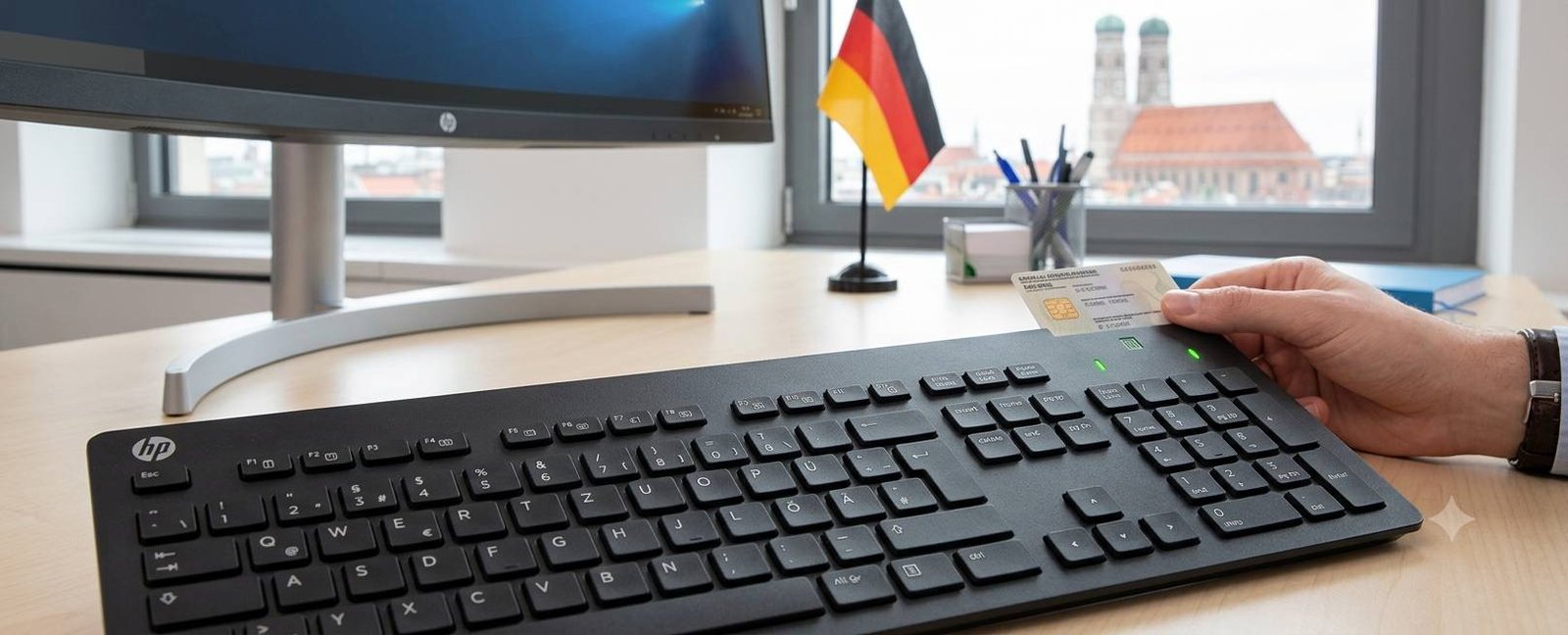
For any organisation handling sensitive data across German-speaking regions, the keyboard is often the last thing anyone thinks about, yet it is the first point of authentication for countless secure systems. Government offices, hospitals, banks, and IT departments across Germany, Austria, and Switzerland rely on smartcard readers built into their input devices to verify identity before opening a single file. Choosing the right hardware, with the correct language layout and reliable card-reading technology, is not a minor detail. It is a decision that affects security, productivity, and staff comfort every single day.
This is precisely where a properly specified device earns its keep. The HP German Smart Card keyboard CCID combines a genuine German QWERTZ layout with an integrated CCID-compliant smartcard reader, giving IT teams a single, dependable tool for login authentication, digital signatures, and encrypted document access. Rather than juggling separate card readers and USB peripherals, staff simply insert their card and type, exactly as intended by the hardware designers.
The Growing Demand for Localised Security Hardware
Businesses expanding into DACH markets (Germany, Austria and Switzerland) quickly discover that a standard English QWERTY keyboard causes more friction than it solves. Umlauts, the sharp S (ß), and the swapped Y and Z positions are not cosmetic differences; they slow typing speed and increase error rates for native German speakers. Pairing that layout mismatch with a bolted-on card reader only compounds the inconvenience.
Why CCID Compliance Matters
CCID, or Chip Card Interface Device, is a USB standard that allows an operating system to recognise a smartcard reader without proprietary drivers. This matters enormously for enterprise IT:
- Plug-and-play recognition across Windows, macOS and Linux systems
- No dependency on outdated or unsupported driver packages
- Consistent performance across large-scale hardware rollouts
- Reduced helpdesk tickets related to card-reading failures
Accessibility Deserves Equal Attention
Security hardware is frequently designed with compliance in mind but accessibility as an afterthought. That approach overlooks a significant portion of the workforce. High Visibility Keyboards and High Contrast Keyboard options, featuring bold, oversized characters, make a genuine difference for visually impaired and low vision seniors who still need to authenticate securely every day. A well-designed keyboard should never force a trade-off between legibility and functionality.
Organisations serious about inclusive workplace technology are increasingly sourcing suppliers who stock both standard and accessibility-focused ranges under one roof. For teams comparing options across multiple language layouts and specialist input devices, browsing CCID German Smartcard Security keyboards alongside high-contrast and oversized-letter alternatives makes procurement considerably simpler, particularly when equipping mixed teams with varying visual needs.
Practical Benefits for IT Procurement Teams
When sourcing keyboards for a German-speaking office, IT buyers should weigh up several practical factors before committing to a bulk order:
- Confirm genuine QWERTZ key mapping rather than a relabelled QWERTY unit
- Check CCID certification to guarantee driverless compatibility
- Verify build quality, since security hardware is used continuously throughout the working day
- Look for spill-resistant or washable models in shared or clinical environments
- Consider high-contrast or oversized-letter variants for accessibility compliance
Where These Keyboards Prove Their Worth
Smartcard-enabled keyboards with a German layout are not a niche accessory; they are essential infrastructure in several sectors.
Public administration: German federal and regional government bodies frequently mandate smartcard authentication for accessing citizen records and internal networks, making CCID compliance a procurement requirement rather than a preference.
Healthcare: Hospitals across Germany and Austria use electronic health card systems (eGK), where clinicians authenticate at shared workstations dozens of times per shift. A dependable, correctly localised keyboard reduces friction at exactly the moment speed and accuracy matter most.
Banking and finance: Digital signature workflows in German financial institutions often require a physical smartcard tap before a transaction can proceed, so reliability under constant use is non-negotiable.
Corporate IT: Multinational companies with German offices need hardware that matches local typing habits precisely, avoiding the productivity dip that comes from staff adapting to an unfamiliar layout.
Getting Implementation Right
Rolling out new authentication hardware across a fleet of workstations benefits from a measured approach. Start with a small pilot group, gather feedback on typing comfort and card-reading speed, then scale the deployment once you’ve resolved any driver or configuration issues. Keeping spare units on hand also prevents downtime when a device eventually needs replacing, particularly in twenty-four-hour environments such as hospitals or call centres.
Secure, Simple, Sorted
Choosing a German QWERTZ smartcard keyboard with genuine CCID support removes a surprising amount of friction from daily operations. It protects sensitive systems, respects native typing habits, and, when paired with high-contrast or oversized-letter options, supports colleagues with visual impairments too. For IT teams equipping German-speaking offices, this small hardware decision delivers outsized returns in security, comfort, and reliability.